Friday, October 20, 2017

Mexican bush sage puts on quite a show at the end of the season. The  flowers are bright purple, fuzzy and dry well. It's a good late season nectar source for pollinators, too. I've also noticed a few honeybees at the red pineapple sage flowers and some late lavender.


Some plants are not as showy, but are still very worthy garden additions. One is nicotiana, or flowering tobacco. It has pretty, white tubular flowers, but what makes it a stand out is fragrance. It's botanically designed to be fragrant at night, in order to attract certain pollinators. When I took Lucy for a walk after supper recently, I stopped to sniff, and was amazed by the sweet aroma of a single bloom. If you have an outdoor seating area that you enjoy at night, nicotiana should be planted nearby.


Even though the gardens are still going strong, I've been busy in the shop gearing up for the holidays. But I'm waiting until November to put out Christmas items!

If you're thinking about making some of your own gifts for the holidays, remember that we have essential oils, DIY supplies and containers and dried herbs and spices in our shop.

Thursday, October 5, 2017

The buckeye butterfly, seen below, is one of the species I've been seeing in increasing numbers this year, as compared to the last few years. Its host plants are verbena, snapdragon and plantain, all of which we have in our yard. Although, while the verbena and snaps are by design, the plantain is not! It does show that having a wide variety of plants will help draw in different varieties.


I just talked to a woman yesterday who wants to add different plants to her yard next year to attract pollinators. People are really interested in increasing habitat and feeding opportunities for bees and butterflies. I think it's paying off, because I saw more species and a larger number of butterflies overall this year.

I'm still seeing an occasional Monarch, too. Yesterday, one fluttered by the kitchen window and today, one few out of a maple tree as Lucy and I walked by.

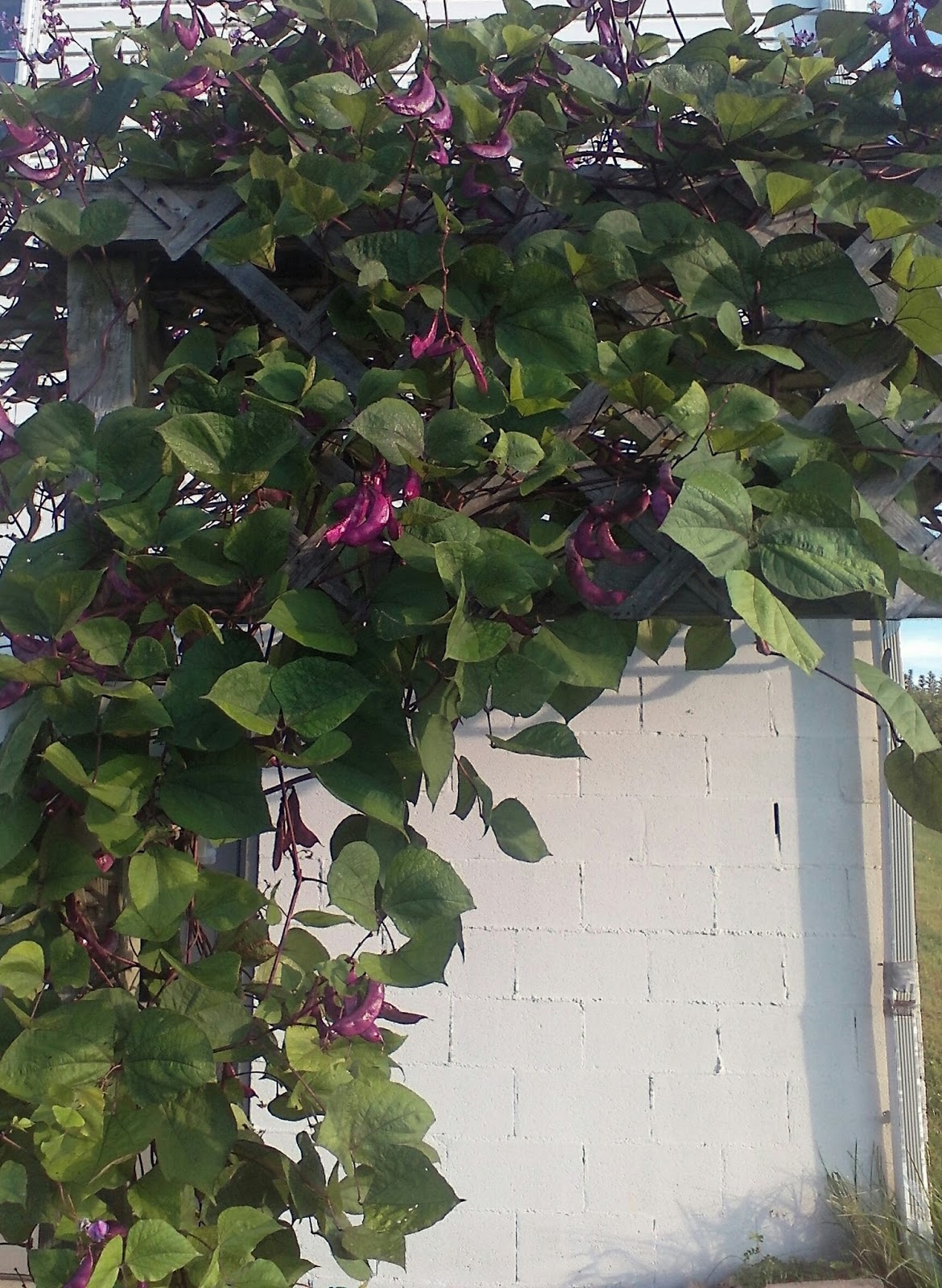
The hyacinth bean vine outside the shop is at its peak. The flowers are attractive, but the shiny purple pods are the real star of the show.


People sometimes dismiss annual vines since they must be planted each year. But with just one season to grow, you get lots of coverage quickly, making them ideal to shade a outdoor seating area. It's easy to save seeds from the hyacinth bean by letting pods dry up on the vine and then harvesting the seeds inside
.

Saturday, September 23, 2017

Some things are worth waiting for, and pineapple sage is one of them. You can enjoy the fragrant foliage throughout the summer, but the red flowers don't appear until the end of the season. Mine has been budded up for awhile, and with the return of sunny, warm weather, the flowers have popped.


Although the leaves have a pineapple flavor, the blooms, to me, are reminiscent of honeysuckle - just a sweet taste. I have made pineapple sage jelly by steeping the leaves in pineapple juice, straining out the leaves and combining the liquid with sugar and Certo and following the directions on the Certo box. Very yummy!

Plumbago looks attractive from mid-summer on. It's a low maintenance, easy to grow perennial that spreads without being invasive like mint. The cobalt blue color is spectacular, especially when combined with white flowers. Remember that it's late to emerge in spring, so don't think it has died over the winter.


Had another question about our hours this week. We're still open five days a week, Tuesday-Saturday 9 to 5. Those hours will continue until Christmas.

Thursday, September 7, 2017

I came across a well travelled praying mantis. He started out on the long outside wall of the greenhouse.


Several days later, he had made it into one of the meandering gardens behind the greenhouse. That's a long trip on those short legs!


Now that we're into September, I'm looking at changes in the garden. The pineapple sage is big and budded up, but no red flowers yet. Calendula and gem marigolds are going strong. Profusion zinnias are still blooming up a storm, and will continue until frost. Flowering on the hyacinth bean vines outside the shop was delayed by the high temperatures in July, but the shiny, purple beans are starting to appear.

Garlic chives are in full bloom. The blossoms can be broken up into individual florets and sprinkled on salad or in soup. Or just leave them for the pollinators. They attract lots of insects.  But be sure to remove the flower stalks as they turn into seed heads. Garlic chives are a rampant reseeder.

Thursday, August 24, 2017

I am very excited about our crop of monarch butterfly caterpillars this year. It's definitely an improvement over the past few years. Today I saw more caterpillars on the swamp milkweed in the pollinator garden. We have a stand of common milkweed that planted itself in the stones behind the second greenhouse. I was never sure why John let it grow there, but it's paid off. More caterpillars on that. Maybe we're finally turning the corner when it comes to replenishing the monarch population.


I tend to judge the passage of time by what's going on in the garden. Spring is the reemergence of perennials and planting annuals. Summer is maintenance and harvesting. As the summer winds down, I see two signs of fall approaching. One is lovely pink anemones blooming. They are a beautiful part shade plant that bloom at the end of the season, rather than in spring, as most part shade flowers do.


The other is the daily gathering of goldfinches on the echinacea outside the greenhouse. They're feasting on the seeds and this year, there are several pairs that visit regularly.

Saturday, August 12, 2017

I know many people poo-poo butterfly bushes as a plant for pollinators. It's not native, some people say it's invasive, although I've never seen that in any of my garden settings, and it's not a host plant. But as a nectar source for a wide variety of butterflies, it's hard to beat. When I took these photos, in addition to the swallowtails and monarch, there were skippers, sulfers, a buckeye, and some small frittilaries feeding.


Although milkweeds serve as both a host plant and a nectar source, that's fairly uncommon. Many plants are either a source of nectar for adult butterflies or a host plant for the caterpillars. Plants like parsley, dill, fennel and rue are host plants for swallowtail butterfly caterpillars, but don't produce much nectar in their flowers. That's why having a wide variety of plants in your garden is so important.

Here is a native plant, Joe Pye weed, providing a meal for a bumblebee.


With the regular rainfall, there's lots to harvest from the garden. Mints, basils, chamomile, savory, lemon balm and verbena, oregano, calendula and more are all drying on my racks. Take advantage of the good weather and harvest now so you can enjoy the garden's bounty after the growing season ends.

Thursday, July 27, 2017

The pollinator situation has improved this summer. We saw quite a few honeybees, more than in the last few years combined. They were all over the thyme walk when it bloomed and now the clover in the yard is keeping them occupied.

We've had a number of monarch butterfly sightings. There are at least a pair, because we've seen two at once. And happily, I found a caterpillar on the swamp milkweed recently. I hope there are more and we have a good crop this year.


There are a lot of swallowtail butterflies around - both the tiger and the black. Caterpillars on the dill and parsley and according to my book, this is a swallowtail chrysalis. The two points on the top seem to be the identifying characteristic. It's on the inside front wall of the greenhouse, which is a protected spot.


Our plant sale continues. We still have a number of nice perennials available and a new crop of basil and dill.

I'm thankful for the break from the very humid weather. Much easier to work outside!