
A big job accomplished! It was time to replace the plastic covering our back greenhouse. The plastic degrades over time, due to the sun‘s rays. It's not a difficult job, but it requires two things.
A calm day and lots of hands, since controlling a 50 foot long piece of plastic can be challenging. John recruited several co-workers, a cousin or two and of course, John and I along with our helper, Jon. There are actually two pieces of plastic, with an air gap
between, to provide some insulation. For the first piece, my job was to stand inside the greenhouse with a very long~handled broom and guide the plastic over the metal hoops. For the second piece, I just helped pull it over the other piece. Then, the guys inserted the wiggle wire (zigzag wire pieces) into channels at each end of the greenhouse to hold the plastic firmly in place. Repeat for the second piece and most of the work is done. That part took about two hours-and just in time, because it began to get breezy then. Trying to control a flapping piece of lightweight plastic in even a gentle breeze is tough. John and our helper finished up the rest of the work in a couple more hours. It looks great and has held up well. A couple days later we had the all-day blowing rain and everything held up.
Lucy had a great time meeting all her new friends. Of course, we had to put her in during the actual operation. Imagine a wild dog running amok over 6 mil plastic.
One day, while walking Lucy, I noticed her with her nose moving along the ground. She wasn't sniffing, but rather walking with her nose directly on the ground. It looked strange and I couldn't imagine what she was doing. When I got close enough, I saw she was following a praying mantis which was walking along. She was just following along, with her nose against it, trying to figure out exactly what it was. It eventually moved off under some cover.
Since then, I've seen mantises frequently. This must be an active time of year for them. And they are all big. On foliage, they’re all green. One that was sitting in a pot, was brown on top green and underneath.
Monday, October 15, 2012

Thursday, September 13, 2012
Butterfly report
I've been keeping an eye on the butterfly population. Although l still think it‘s down overall from previous years, l have seen an uptick. We continue to have loads of the little ones-lots of small fritillaries, white loopers and others and pretty many sulfers.
I've seen only a handful of monarchs, although l was happy to see some caterpillars on the swamp milkweed. We have tons of the wild milkweed out back, so hopefully there are caterpillars feasting there too. Not too many swallowtails, but I have seen more in the past two weeks. l've seen caterpillars on dill, fennel, rue and parsley and saw a black swallowtail laying eggs on the parsley this Week.
The one species I've noticed in abundance is the buckeye. It’s medium-sized, brown with some yellow and orange markings, but very noticeable for the round spots or eyes on the outer edges of its wings. Turns out the caterpillars feed on plantain, verbenas and snaps, all of which we have, so l guess it‘s just a buffet for them.
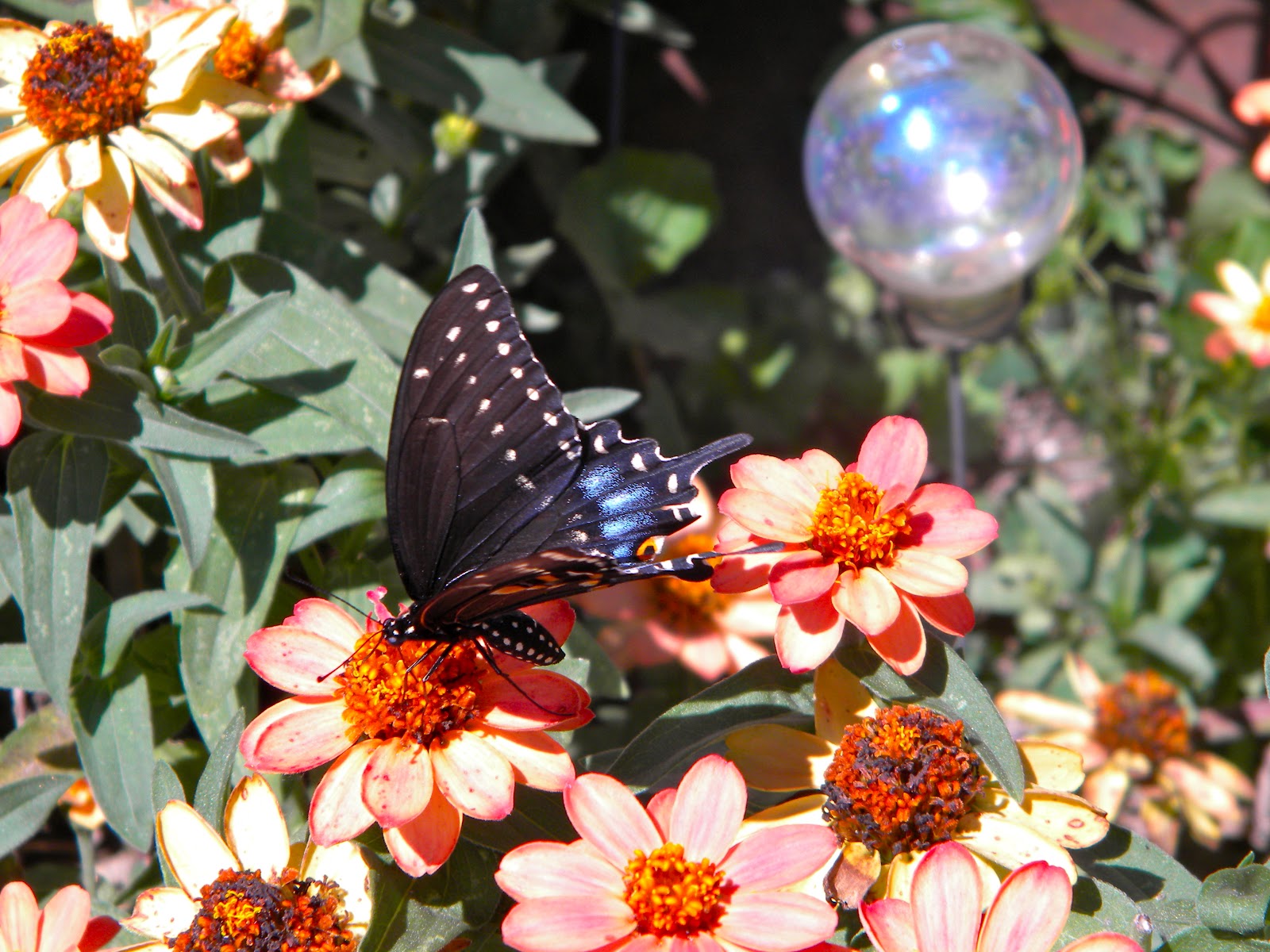
The painted lady was sitting in a patch of pink profusion zinnias and boy, are they spectacular this year. Plenty of rain made for lush growth and plenty of sun means loads of flowers. The colors~cherry pink, orange and deep apricot are all so rich and the white is bright and clear. They bloom constantly and require very little deadheading. And never a lick of mildew on them since l've grown them. l always give them the most bang for your buck award. I love the tall old~fashioned zinnias with their wide color range, but no matter how I site them they always seem to develop mildew.
l‘m reducing large harvests on woody-stemmed perennials like thyme, sage and rosemary to allow plenty of foliage to remain for winter protection. Can still harvest and use-just don't cut back the whole plant or cut back really hard.
Saturday, September 8, 2012
I've been watching a pair of goldfinches who are coming daily to feast on the seeds of purple coneflower. We have two big stands of purple coneflower, or echinacea, and a smaller patch of the white. l notice the birds most in the patch in front of the greenhouse, although they also visit the medicinal meandering garden. I never cut coneflowers back in the fall, leaving the seedheads for the birds is the winter, but the way these two are going at it, there may not be any left this winter.
 I was sitting outside one day and l noticed a beautiful combo in the four~square garden. The tall white garlic chive flowers were in full bloom and behind them, in the background, was the intensely purple foliage of ‘Red Rubin* basil. Also, in the picture were the bright yellow and orange blossoms of calendula. Just a lovely combination! Speaking of garlic chives, the bees are absolutely delirious over the flowers-they were loaded with bees yesterday. My practice is always to let the bees work the flowers till they're satisfied and then out them back. Because garlic chives reseed so prolifically, l cut them back when the seed heads are still green, hopefully eliminating reseeding. Although I just found another bit that popped up somewhere they didn't belong, so l must be even more ruthless.
I’m noticing an effect of the extremely high temperatures in July. Many plants will not set buds when temps get high (usually above 85 or 90 degrees). So late-bloomers are definitely being delayed. Hyacinth bean vine is just blooming now, so the bean crop will be down. I‘ve seen only one flower on nina or firecracker vine, also an annual vine with sprays of yellow, orange and red flowers. Then I went looking at the late sages. 1've seen only a few small buds forming on both the mexican bush sage with fuzzy purple flowers and pineapple sage with red tubular blooms, Hopefully, we'll have a late frost season and still get to enjoy these late season beauties.
The greenhouse and herb shop remain open 5 days a week~Tuesday-Saturday 9-5. Many people think we shut down after the plant sale.
Not so!

I’m noticing an effect of the extremely high temperatures in July. Many plants will not set buds when temps get high (usually above 85 or 90 degrees). So late-bloomers are definitely being delayed. Hyacinth bean vine is just blooming now, so the bean crop will be down. I‘ve seen only one flower on nina or firecracker vine, also an annual vine with sprays of yellow, orange and red flowers. Then I went looking at the late sages. 1've seen only a few small buds forming on both the mexican bush sage with fuzzy purple flowers and pineapple sage with red tubular blooms, Hopefully, we'll have a late frost season and still get to enjoy these late season beauties.
The greenhouse and herb shop remain open 5 days a week~Tuesday-Saturday 9-5. Many people think we shut down after the plant sale.
Not so!
Friday, August 24, 2012
Birds in a Greenhouse!
Birds in the greenhouse! Sounds kind of like "Snakes on a Plane" although not as problematic.
Nearly every year, we get a few wayward birds that fly into the greenhouse, more often the back greenhouse. Usually, I just duck down, walk behind the birds and shoo them towards the door and they fly out. This works unless the birds are young or dumb. This year, a young mockingbird got in greenhouse #3 and couldn't get out. I tried shooing, but although he'd fly toward the front, he'd veer off to the side instead of flying out the door. Mockingbirds can be nasty, but this one was just dazed and tired. He was flapping against the front wall, so I scooped him in a bucket, threw a box over the top end get him outside. He flew away unscathed.
Mourning doves are also difficult, because they're too dumb to fly out on their own. Usually have to throw a towel over them and rescue and release.

Recently, we had a tougher challenge. Walked into the greenhouse, heard a strange noise, looked up and saw a hummingbird hovering near the top of the greenhouse. Once, when I worked in the garden center, we had a hummingbird inside~we got it out eventually, but it took a while and wasn't easy. Luckily, John was home when this happened.
The poor thing was tired from hovering constantly. It perched on the frame around the fan on the back wall. John got up on the bench with a bucket, figuring he‘d scoop her (it was e female) into the bucket. The little thing hopped on the edge of the bucket end sat there. John handed me the bucket and I slowly walked out of the greenhouse with it perched there the whole time. It sat on the bucket a few minutes to recover then flew off and rested in a tree.
Then I go into greenhouse #2 and see a small wren hopping around on the floor. By the time I got John and we came back in, we couldn't see it. It was way in the back though, and we hadn‘t seen it fly out. Looked on the back wall and saw it stuck in the web of one of the large, writing spiders that live there, John released it and we scooted it out, only to be met by Lucy! She didn‘t hurt it~it hopped under a tree and eventually flew away. I'd much rather have toads in the greenhouse!
Wednesday, August 15, 2012
I'm enjoying summer (except for the hot weather) as the days and weeks tick by. Summer always has a vacation feel to me, even though I'm long, long removed from school and the idea of summer vacation.
And even though we continue to be open full~time, and I have plenty of work to do, it’s not super busy like spring, which I guess leads to the lazy, summertime feel.
 There are things that represent summer to me as I look arcane-big clumps of blooming coneflower, bushes of tomato and pepper plants and butterfly bushes fragrant basil, cheerful calendula flowers, purple blooms atop white Russian sage stems loaded with blooms.
I do think the butterfly population is down this year, both in number and variety. The only type I've seen in profusion are the cabbage whites and their related cousins. l've seen a handful of larger species - monarchs and swallowtails (more black than yellow and black) and also buckeyes, a few commas, fritillaries, red admirals and skippers. I think numbers have declined steadily since we moved in fifteen years ago. And it’s not for lack of nectar sources.
I've been admiring a new flower I planted ~ amberboa. Haven't found a common name for it, but it'e in the aster family, so l'll call it an annual aster. Very fine texture ~ narrow, linear leaves with a pretty, mauve flower with thin, spidery petals. I found it in a catalog and the picture and description were quite accurate. I planted five in a clump ~ with the fine texture, 1 think you need 3, 5, or more for show. l‘ll have to wait till next year to see if they reseed.
l've been cutting back perennials after they bloom to neaten them up and encourage rebloom. Ditto for deadheading annuals. I had the super dark-almost black~cornflowere that never died over the mild winter. They actually got almost as tall as me end bloomed for months. I finally cut them down and now have a new crop of seedlings emerging from dropped seed.
The plant sale continues~don't have a huge selection left~but prices are dirt cheap!
And even though we continue to be open full~time, and I have plenty of work to do, it’s not super busy like spring, which I guess leads to the lazy, summertime feel.

I do think the butterfly population is down this year, both in number and variety. The only type I've seen in profusion are the cabbage whites and their related cousins. l've seen a handful of larger species - monarchs and swallowtails (more black than yellow and black) and also buckeyes, a few commas, fritillaries, red admirals and skippers. I think numbers have declined steadily since we moved in fifteen years ago. And it’s not for lack of nectar sources.
I've been admiring a new flower I planted ~ amberboa. Haven't found a common name for it, but it'e in the aster family, so l'll call it an annual aster. Very fine texture ~ narrow, linear leaves with a pretty, mauve flower with thin, spidery petals. I found it in a catalog and the picture and description were quite accurate. I planted five in a clump ~ with the fine texture, 1 think you need 3, 5, or more for show. l‘ll have to wait till next year to see if they reseed.
l've been cutting back perennials after they bloom to neaten them up and encourage rebloom. Ditto for deadheading annuals. I had the super dark-almost black~cornflowere that never died over the mild winter. They actually got almost as tall as me end bloomed for months. I finally cut them down and now have a new crop of seedlings emerging from dropped seed.
The plant sale continues~don't have a huge selection left~but prices are dirt cheap!
Friday, July 20, 2012
Hot Weather Tips
In the hot weather, outside work continues, although I start earlier (sometimes 7am) so I can finish up by noon and retreat inside during the hottest part of the day. I've been drying lots of culinary herbs - mints, basil, tarragon, thymes, catnip, chamomile, and savory. I'm also drying flowers for use and sale in the shop - lavender is done, along with yarrow, love-in-a-mist seed pods, larkspur and cornflower. Now I'm working on annual statice, showy kent beauty oregano and herrenhausen oregano. These are both wonderful plants -grown not for flavor, but for their pretty flowers.
After perennial flowers have bloomed, it's a good idea to cut them back. After blooming, they often decline in appearance. Cutting them back hard - usually to a few inches above the ground, encourages the emergence of new growth. You'll often see new growth at the base or in the middle of the plant. This indicates the plant will benefit from hard trimming. Some perennials will rebloom later in the season if they are cut back after their first bloom.
Lots of people have been admiring our hollyhocks once they bloomed. They did not reseed particularly well this year. I think many seeds rotted or washed away with last fall's flood. But the ones that did come back are lovely. So many people talk about a relative having hollyhocks in their yards. Most do not remember them having rust. Rust is a fungus disease caused by spores which proliferate in hot, humid weather. Rust and other fungal diseases like powdery mildew must be treated with a fungicide. Remember, it will not remove the fungus on the plant, it will only prevent it from getting worse. In order to have clean plants, you must treat them before you see any signs of rust, and continue through the hot, humid weather.
Starting to see some more, larger butterflies - a couple monarchs, black swallowtails, and red admirals. I saw a monarch feeding on butterfly weed. This is a 'cousin' to wild milkweed and also swamp milkweed, which are host plants for the monarch caterpillars, as well as nectar sources for butterflies.
Our plant sale continues. Lots of good prices! Try a new plant or tuck in another in an empty spot in the garden.
After perennial flowers have bloomed, it's a good idea to cut them back. After blooming, they often decline in appearance. Cutting them back hard - usually to a few inches above the ground, encourages the emergence of new growth. You'll often see new growth at the base or in the middle of the plant. This indicates the plant will benefit from hard trimming. Some perennials will rebloom later in the season if they are cut back after their first bloom.
Lots of people have been admiring our hollyhocks once they bloomed. They did not reseed particularly well this year. I think many seeds rotted or washed away with last fall's flood. But the ones that did come back are lovely. So many people talk about a relative having hollyhocks in their yards. Most do not remember them having rust. Rust is a fungus disease caused by spores which proliferate in hot, humid weather. Rust and other fungal diseases like powdery mildew must be treated with a fungicide. Remember, it will not remove the fungus on the plant, it will only prevent it from getting worse. In order to have clean plants, you must treat them before you see any signs of rust, and continue through the hot, humid weather.
Starting to see some more, larger butterflies - a couple monarchs, black swallowtails, and red admirals. I saw a monarch feeding on butterfly weed. This is a 'cousin' to wild milkweed and also swamp milkweed, which are host plants for the monarch caterpillars, as well as nectar sources for butterflies.
Our plant sale continues. Lots of good prices! Try a new plant or tuck in another in an empty spot in the garden.
Tuesday, July 17, 2012
Seasonal Progression
I've always enjoyed the progression of the seasons, so much so that I think I'd have a hard time living in an area that didn't see a seasonal change.
Growing up in Mt. Gretna, PA, it was simple to see the change. Spring brought all the new growth in the woods, new green leaves unfurling and the discovery of all the woodland flowers, like Jack in the pulpit, trailing arbutus and lady's slippers. And the rhododendrons - Wow! Summer was magical with the whole place awakening (this was in the old days when year-round residents were in the minority). Lots of cool green shade and days spent at the lake. Autumn was perhaps the best - beautiful, brilliant foliage and the lovely leaf mold smell. And winter was quiet and white like a blanket had been pulled up around you.
I still love that progression. I think of it in the vegetable garden. How fun to pick the first sugar peas and cook them up. I have a few recipes I pull out to enjoy as soon as they start. Then the small but sweet alpine strawberries. I enjoy them on cereal, but my favorite is to just eat them in the garden, still warm from the sun. Then the wild black raspberries - so sweet. Next, green beans and yellow beans so I can make three bean salad. Then tomatoes to enjoy with all the basil I've grown, and peppers too. I've stopped growing cukes, since I no longer make pickles. And I've never grown squash. There are so many floating around and someone's always looking to give some away.
Lucy loves the garden too. All I have to say is let's go pick sugar peas or beans and off she goes. Strawberries she'll pick by herself and she also loves raspberries and mulberries.
Of course, the flower gardens present the same progression. Early spring starts with bleeding hear, candytuft, columbine and dame's rocket. Close on their heels are big, beautiful oriental poppies and fragrant dianthus. Then, spiky purple catmint and lavender along with pink Jupiter's beard and bright magenta rose campion. Summer brings daylilies, yellow St. John's wort, echinacea, anise hyssop, black-eyed Susans and brilliant blue plumbago. A feast for the eyes!
Growing up in Mt. Gretna, PA, it was simple to see the change. Spring brought all the new growth in the woods, new green leaves unfurling and the discovery of all the woodland flowers, like Jack in the pulpit, trailing arbutus and lady's slippers. And the rhododendrons - Wow! Summer was magical with the whole place awakening (this was in the old days when year-round residents were in the minority). Lots of cool green shade and days spent at the lake. Autumn was perhaps the best - beautiful, brilliant foliage and the lovely leaf mold smell. And winter was quiet and white like a blanket had been pulled up around you.
I still love that progression. I think of it in the vegetable garden. How fun to pick the first sugar peas and cook them up. I have a few recipes I pull out to enjoy as soon as they start. Then the small but sweet alpine strawberries. I enjoy them on cereal, but my favorite is to just eat them in the garden, still warm from the sun. Then the wild black raspberries - so sweet. Next, green beans and yellow beans so I can make three bean salad. Then tomatoes to enjoy with all the basil I've grown, and peppers too. I've stopped growing cukes, since I no longer make pickles. And I've never grown squash. There are so many floating around and someone's always looking to give some away.
Lucy loves the garden too. All I have to say is let's go pick sugar peas or beans and off she goes. Strawberries she'll pick by herself and she also loves raspberries and mulberries.
Of course, the flower gardens present the same progression. Early spring starts with bleeding hear, candytuft, columbine and dame's rocket. Close on their heels are big, beautiful oriental poppies and fragrant dianthus. Then, spiky purple catmint and lavender along with pink Jupiter's beard and bright magenta rose campion. Summer brings daylilies, yellow St. John's wort, echinacea, anise hyssop, black-eyed Susans and brilliant blue plumbago. A feast for the eyes!
Subscribe to:
Posts (Atom)
